

48%
of searches display an AI answer
ChatGPT, Perplexity, Gemini and Google's AI-generated answers respond directly, citing a handful of sources. GEO is about becoming one of those sources when the question relates to your business.
of searches display an AI answer
of cited sources rank in the top 10
of consumers use AI to research or shop
of searches end without a click
Someone looking for a service provider no longer necessarily types three words into Google. They describe their situation to ChatGPT and ask what to do, or who to contact. The answer arrives in seconds, with two or three names and reasoning that appears neutral.
That reasoning is not neutral. It is built from what the model finds about you, your competitors and your market. If your site is poorly structured, your information differs from one platform to another, or nobody talks about you outside your own website, the model has no basis for citing you. It will cite someone else.
The key point is that this is already happening, whether you have addressed it or not. The first step is not to produce content. It is to see what these tools currently say when asked about your business.
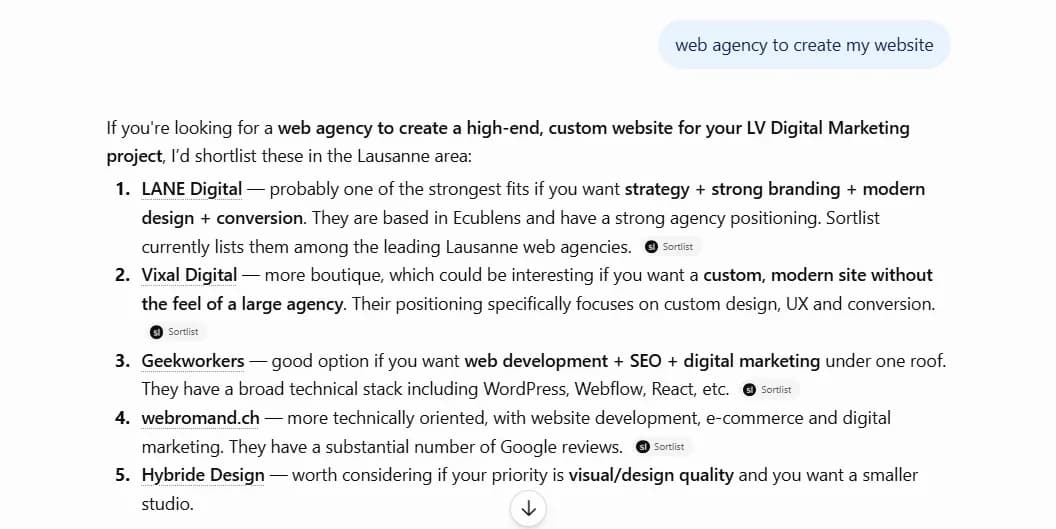
Unlike a search engine that ranks pages, a generative model builds an answer. Understanding how it builds that answer shows you where to act.
Generative engines use their own crawlers, separate from Google's. Many sites block them without realising it, through a misconfigured file, overly strict bot protection or content that only appears after running scripts these crawlers cannot read. This is the starting point, and the one most often overlooked. A site these systems cannot access will never be cited, however good its content.
Methodology

Systematic testing of several models using a set of questions representative of your business and location. The audit records who is cited, for which questions and from which sources, as well as what the models say about you when asked directly. This initial assessment is quantified and provides the baseline for all subsequent tracking.
Checking whether AI crawlers can access your site, how your pages render without running scripts, how your content is structured and which structured data is in place. This step regularly uncovers complete access blocks that are invisible in a browser.
Identifying the wording your customers actually use. The focus shifts from three-word keywords to complete questions: the ones people ask AI when looking for a provider, comparing solutions or checking a price. This mapping shapes the entire content plan.
A practical document organised by impact and effort: technical fixes to apply, pages to restructure, content to create for related questions, structured data to implement and third-party platforms where you need a presence. Each item is described in enough detail to implement without back-and-forth.
Your team or developer applies the fixes, with regular check-ins to resolve blockers and validate what is live. I focus on strategy and verification. If you do not have technical resources, implementation can be entrusted to a trusted partner.
A fresh citation review using the same questions as the initial audit, compared with the previous month and your competitors. What improves is reinforced; what stalls is reworked. A report with commentary sets out priorities for the following month.
5 ★ on Google
Trust is built through the work. It also comes through in their words. View all reviews on Google